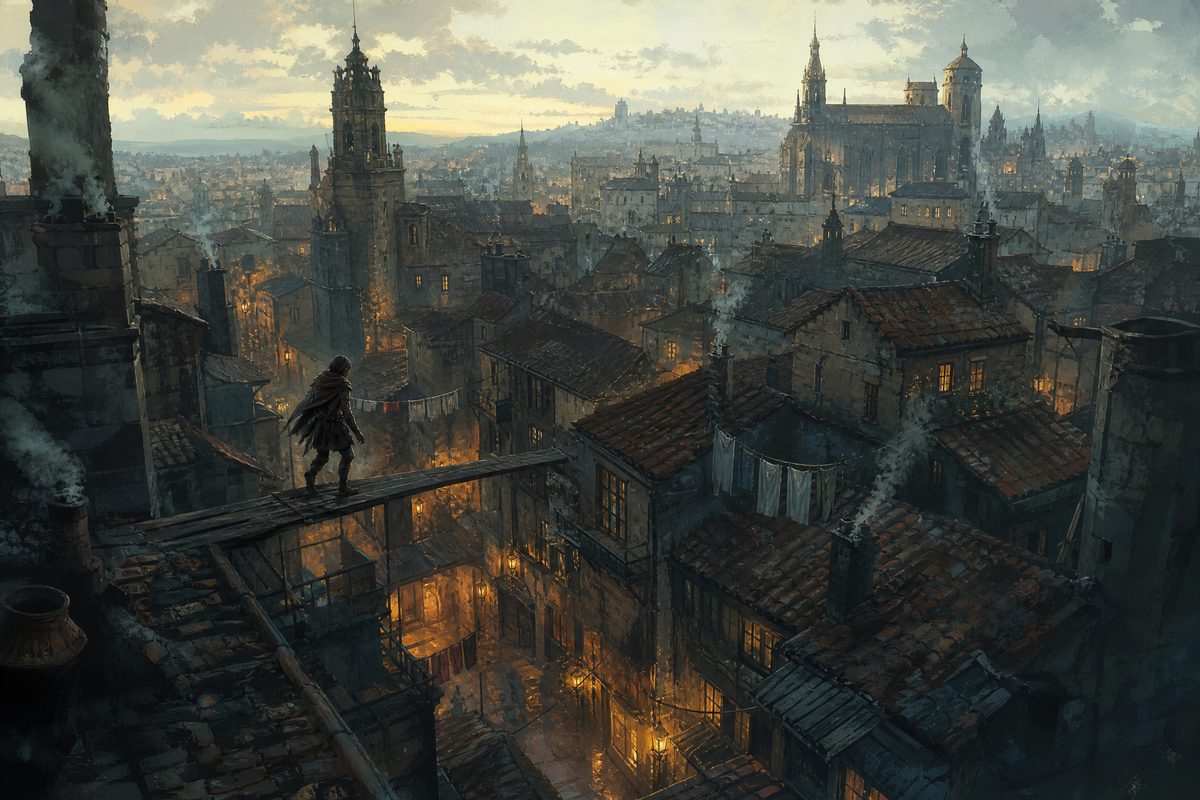
Cities are the hardest thing to navigate in games and the most commonly ruined. The standard failure is a beautiful dense district that is functionally a corridor, or a genuinely open city rendered navigationally meaningless by a minimap that turns every journey into following a line. Tallow Quarter avoids both, and the mechanism it uses is so quiet that I did not consciously notice it until hour nine.
Every business in the city hangs a painted sign, and the signs follow rules. Trades have shapes: a circle for anything to do with grain, a diamond for metalwork, a crescent for cloth. Districts have colours: the river district paints its sign borders green, the upper terraces use dark red, the tannery quarter uses a brown so specific it is unpleasant. Nothing explains this. It is simply true, everywhere, without exception.
What learning the city actually felt like
The first four hours are disorienting in the productive sense. You are given an errand, a district name and no direction, and you find the place by asking, walking and being wrong. This is where most games would insert a marker, and where Tallow Quarter instead inserts a passer-by who tells you to head for the green signs and turn uphill at the fountain with the broken rim.
By hour ten I no longer read the signs individually. I read the colour of a sign at the end of an alley and knew which district it opened into, which is a genuinely different mental state and one I have not reached in a game city before. The signs had stopped being decoration and become a compass, and I never learned them deliberately.
The moment the system announces itself is the moment you take a shortcut you have never taken, purely because the sign colours at the far end told you where it would come out.
The fountains, which are the real spine
Underneath the sign system sits a second one: eleven fountains, one per district plus two on boundaries, each visually distinct. One has a broken rim, one is dry, one has been converted into a flower bed, one is enormous and clearly the civic centrepiece. All eleven are at junctions of at least four ways.
These are the city's long-range references, the equivalent of the three lighthouses in Fathom Coast but arranged as a network rather than a line. Because every fountain is a junction, and every junction is a fountain, the city has a skeleton you can hold in your head: eleven nodes and the routes between them, with everything else hanging off it.
| District | Sign border | Fountain | Learned by hour |
|---|---|---|---|
| River | Green | Broken rim | 4 |
| Upper terraces | Dark red | Civic, large | 7 |
| Tannery | Brown | Dry basin | 9 |
| Warehouse row | Slate grey | Flower bed | 12 |
| Scholars' hill | Pale blue | Twin spouts | 16 |
| Outer wall | Unpainted | None | 24 |
The two places it fails
The outer wall district has no fountain and no sign convention, because it is poor and the fiction says so. That is good writing and bad navigation, and it is the only part of the city I never learned. My memory sketch has it as a vague grey band with two buildings in it. Whether that is a flaw or the point is genuinely arguable, and the review is going to say flaw, because thirty hours in I was still asking directions there.
The second failure is the fast travel unlocked at hour twenty. It is well designed — you can only travel between fountains, which reinforces the skeleton rather than bypassing it — but it arrives at exactly the moment the city has become legible, and the four hours after unlocking it are the only hours in which my repeated-route count went back up. I stopped walking, and stopped noticing.
What the log shows
Marker reliance is four per cent, which comes entirely from three escort sequences where a companion is marked. Those three sequences are also the only ones where I got lost after hour twelve, which is a small joke the game is probably not making deliberately.

Verdict
Tallow Quarter is the most generous game in this volume. Where Fathom Coast withholds and trusts you to cope, this teaches constantly without ever instructing, and the difference in feel is enormous — thirty-four hours in the city were pleasant in a way that eleven hours on the southern coast were not.
It loses half a point to the outer wall and half to the fast travel timing, and it earns everything else. If a studio wanted one worked example of how to make a city learnable without a minimap, this is now the example I would point at.