The first thing Fathom Coast does is refuse. There is no map screen, no compass ribbon, no minimap in the corner and no marker on the horizon. There is a coastline, a low sun, and a character who walks at a pace that makes you look at things. For the first two hours this feels like an affectation, the sort of decision a studio makes to be talked about. By hour eleven it has become the reason the game works.
What replaces the map is a shoreline with an unusually distinct silhouette. The coast runs roughly north for its whole length, and every few kilometres it does something memorable: a stack of three rocks in descending height, a bay so round it looks drawn with a compass, a river mouth wide enough to need a ferry. None of these are marked. All of them are unmistakable, and that is the entire navigation system.
Three lighthouses and everything they do
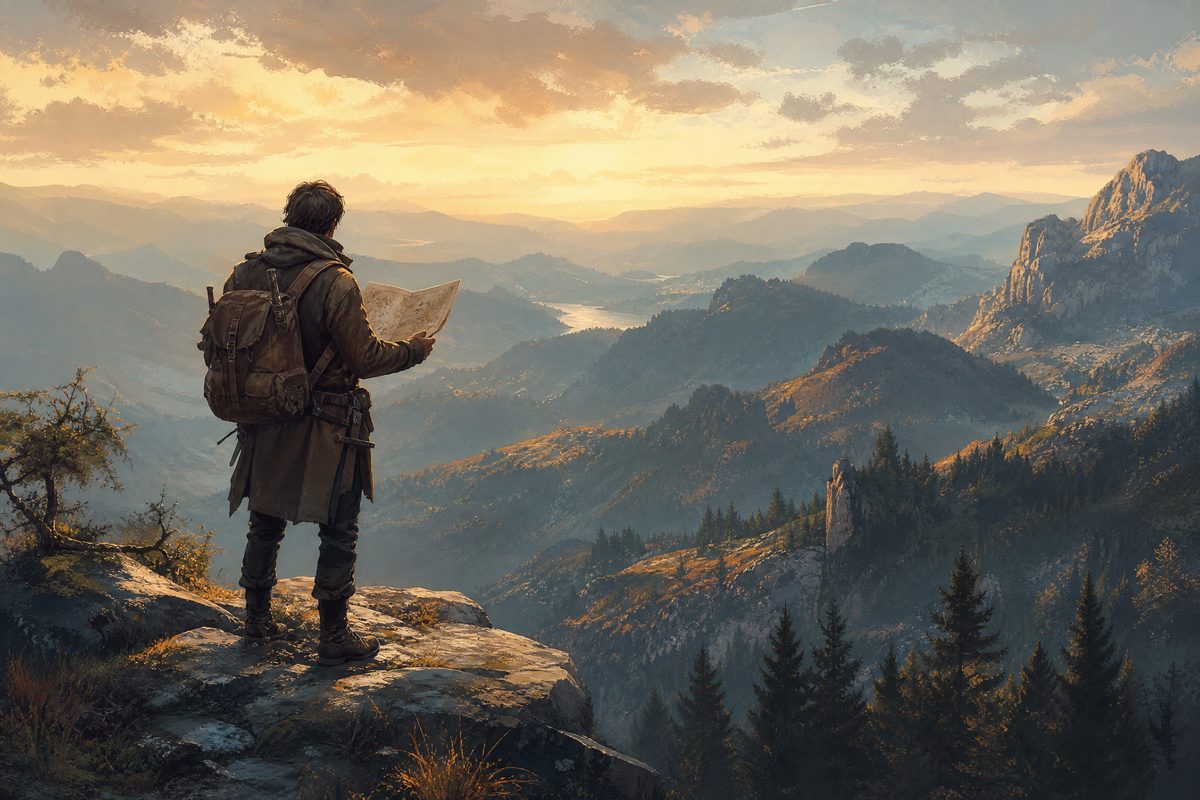
The clever part is the lighthouses. There are three, placed at roughly even intervals along the coast, each with a different tower profile — one squat and banded, one tall and plain, one leaning slightly inland. At night each flashes at a different interval. From almost any point on the coast you can see at least one, and from a good vantage you can see two.
That is enough to fix your position. Two lighthouses with known profiles, at known relative bearings, and you know where you are within a kilometre. It is a real navigation technique, implemented without a single line of tutorial text, and the moment you work it out for yourself is the best moment the game has.
I spent about twenty minutes on a beach at hour fourteen deliberately triangulating my position from two towers, purely because I could. No game with a minimap has ever given me a reason to do that.
The lighthouses are also the only structures in the game visible from a distance greater than about two kilometres. Everything else — villages, wrecks, the two inland farms — is hidden until you are close. The result is a world with three long-range reference points and dozens of short-range ones, which is very close to how navigation works outdoors.
The eleven-hour problem
It takes eleven hours to reach the first signpost, and those eleven hours are the weakest part of the game. Not because they are unguided but because they are undifferentiated: the southern coast is the least distinctive stretch, the lighthouse there is the plainest of the three, and a new player has not yet learned that the coastline itself is the information.
I got genuinely lost twice in that stretch, in the bad sense — not enjoyably disoriented but simply unable to tell whether I had walked this beach before. Both times the fix was the same: walk to the water and follow it. The game knows this and never says it, and I am not sure that restraint is correct. A single line from an early character about keeping the sea on your left would have cost nothing.
What the log shows
Marker reliance is zero, which is trivially true because there are no markers. The more interesting figure is repeated-route count: how often I walked a stretch I had already walked. It fell from fourteen repeats in the first ten hours to two in the last ten, which is the shape of a world being learned rather than a world being consumed.
| Stretch | Hours | Repeated routes | Times lost |
|---|---|---|---|
| Southern coast | 0–11 | 14 | 2 (badly) |
| Middle bays | 11–24 | 6 | 3 (briefly) |
| Northern cliffs | 24–36 | 3 | 1 (briefly) |
| Far shore | 36–41 | 2 | 0 |
Where it stumbles
Two failures, both mechanical rather than conceptual. The first is the inland detour around hour twenty-six, where the coast becomes impassable and the route moves into forest for about ninety minutes. The forest has no long-range references at all, no lighthouse visibility, and a canopy that hides the sun. It is the one section where the design's principles produce simple frustration, and it goes on twice as long as it should.
The second is night. Nights are genuinely dark, which is correct, and the lighthouse flashes are the only navigational aid, which is elegant. But the game does not model cloud, so a night is either fully useful or fully useless depending on nothing at all. Weather that occluded the towers occasionally would have made the system better rather than worse.
The drawing test
A week after finishing I sat down and drew the coast from memory. The sketch has all three lighthouses in the right order and roughly the right spacing, both river mouths, the round bay, the northern cliffs, and the inland detour marked as a loop. It misplaces two villages and forgets a small island entirely.
That is the best result in six volumes. For comparison, my sketch of Marker Fields — a game I played fifty per cent longer — is a blank page with four unconnected dots on it, which is a fair description of what sixty-two hours of following a waypoint leaves behind.
Verdict
Fathom Coast is not the best game in this volume and I would not argue that it is. Its combat is thin, its story is a series of quiet gestures, and eleven of its forty-one hours are noticeably weaker than the rest. What it is, unambiguously, is the best-navigated world I have logged, and the clearest demonstration that a memorable geography is built by withholding information rather than presenting it well.
The correct comparison is Tallow Quarter, which achieves something similar in a city and does it with more generosity. Between the two, they make the argument in The Compass Tax difficult to dismiss.