The pause menu contains a sheet of squared paper, a pencil that draws single-cell lines, and four stamps: junction, water, drop, and a blank circle you can use for whatever you want. That is the map. It starts empty and stays empty unless you fill it in, and nothing in the game will ever fill it in for you.
This is an old idea revived carefully. What makes it work here is not the drawing tool, which is functional and slightly fiddly, but the cave design behind it: every junction is visually distinct, every distinct junction is worth a stamp, and the layout is dense enough that a well-kept map is dramatically more useful than a badly kept one. The system has teeth.
How the drawing changes how you look
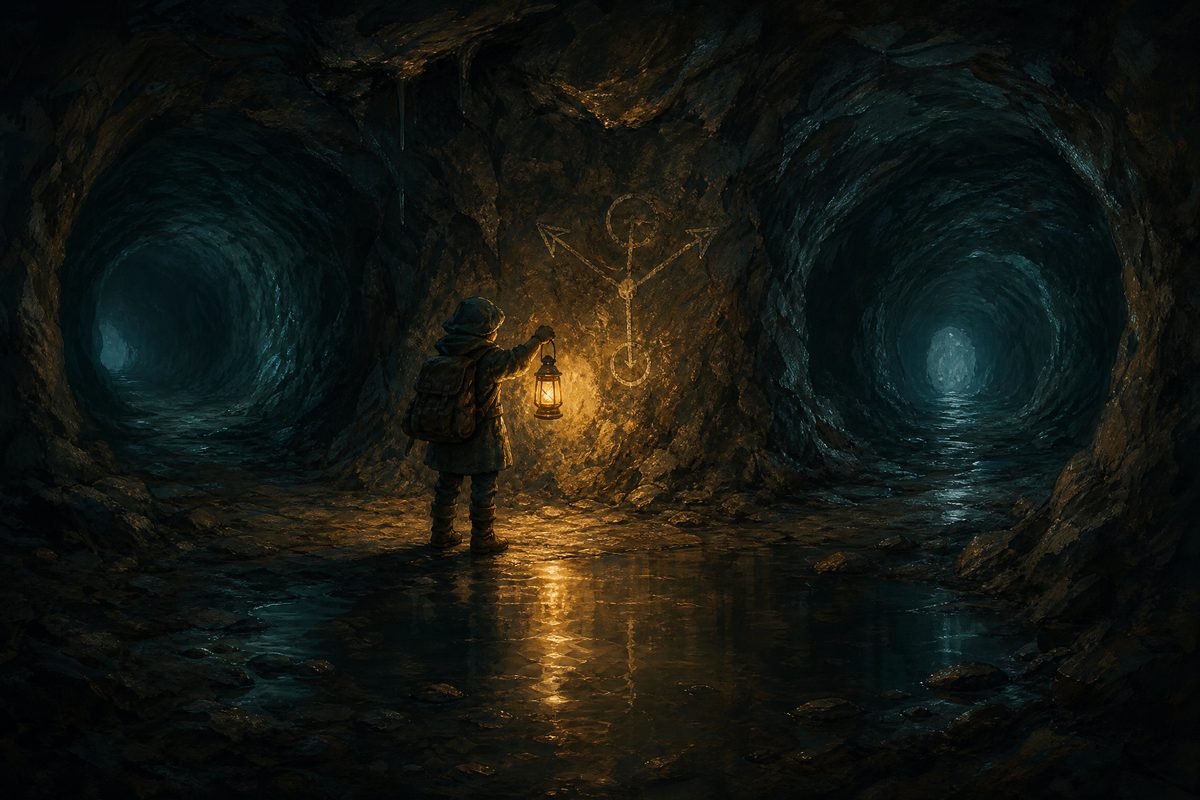
Within an hour I was playing differently from how I play anything else. Arriving at a junction, I stopped, looked at all three exits, decided which was the one I would recognise again, and stamped it. That decision — which of these will I know later — is a navigational judgement no other game in this volume asked me to make.
By hour six my map had a personal notation. Blank circles meant water I could not cross yet. Two circles side by side meant a dead end with something in it. A junction stamp with a line trailing off nowhere meant I had heard something down there and not gone. None of this was designed; all of it emerged, and re-reading my own map at hour thirty was like reading a diary.
The best twenty minutes the game gave me were spent lost in a region I had mapped badly at hour nine, recognising my own carelessness, and fixing it.
Where the design carries the idea
Three things make the cave system mappable. Water always flows downhill and always eventually reaches the same three sumps, so a stream is a bearing. Ceiling height varies enough to be memorable, and the tall chambers are all connected to each other by short passages. And light: eleven places in the whole cave system have natural light from above, and every one of them is a landmark you cannot mistake.
The eleven light shafts do the same work as the three lighthouses in Fathom Coast, and are the reason the deep sections remain navigable. Between them the caves are genuinely disorienting, which is correct, and I got badly lost four times, all of them enjoyable except one.
| Region | Hours | Cells mapped | Map accuracy |
|---|---|---|---|
| Upper galleries | 0–9 | 210 | Poor — redrawn later |
| Cisterns | 9–19 | 340 | Good |
| Flooded reach | 19–29 | 265 | Good |
| Deep column | 29–40 | 190 | Excellent |
The one bad stretch
The flooded reach around hour twenty-two has a section where three chambers are near-identical and the water hides the floor detail that would tell them apart. I spent about fifty minutes there in the wrong kind of lost — not exploring, just checking the same three exits repeatedly — and my map of that region is still wrong.
Every other difficult section gave me something to work with. That one gave me nothing, and in a game built entirely on the promise that careful attention will be rewarded, a section that punishes attention is a real fault rather than a rough edge.
Why recall is only partial
The drawing test produced an odd result. My sketch of the cave system a week later is detailed for the deep column, accurate for the cisterns, and almost blank for the upper galleries where I spent the first nine hours. That is the opposite of the usual pattern.
The explanation is the map itself. In the upper galleries I was learning to use the tool and relying on it heavily, so I never memorised anything. In the deep column my map was good enough that I stopped opening it, and that is where the layout went into memory. Which suggests something uncomfortable about player-drawn maps: they can substitute for memory exactly as a minimap does, just more slowly.
Verdict
Lantern Deep is the most interesting game in this volume and not the best-navigated one, which is an unusual pair of sentences to write. It asks more of the player than anything else here and gives back more per hour, and its one failed section is failed in a way that matters because of how strong the rest is.
Set against Marker Fields, the contrast is almost comic: sixty-two hours of a game drawing the map for you leaves nothing behind, and forty hours of drawing it yourself leaves a physical artefact you can still read. That comparison is the whole argument of this publication, made twice in one volume.